
History · Storms · Weather
The Hurricane Scale That Was Built for Buildings
The Saffir-Simpson scale began with a United Nations housing study, gained urgency after Hurricane Camille, and became public despite concerns it would be misunderstood.
A hurricane’s category can become the most repeated fact about it. The number appears in headlines, television graphics, forecasts, social media posts, and conversations between people deciding whether they should prepare. A Category 4 sounds plainly more dangerous than a Category 2, and for wind, it is.
The familiarity of those five categories makes the scale feel almost inevitable, as though meteorologists developed it from the beginning as a complete measure of hurricane danger.
That is not what happened.
The scale began not in a forecasting office, but in a structural engineer’s effort to protect low-cost housing. The meteorologist who helped turn it into a hurricane warning tool had nearly drowned in a storm at age six, and the devastation of Hurricane Camille later exposed the need for a clearer way to communicate risk. The scale reached the public gradually and took on the Saffir-Simpson name to the surprise of both men. Decades later, officials removed storm surge from the scale because linking it to wind categories could mislead the public.
Even its familiar category boundaries have moved.
It began with building codes, not hurricane forecasts
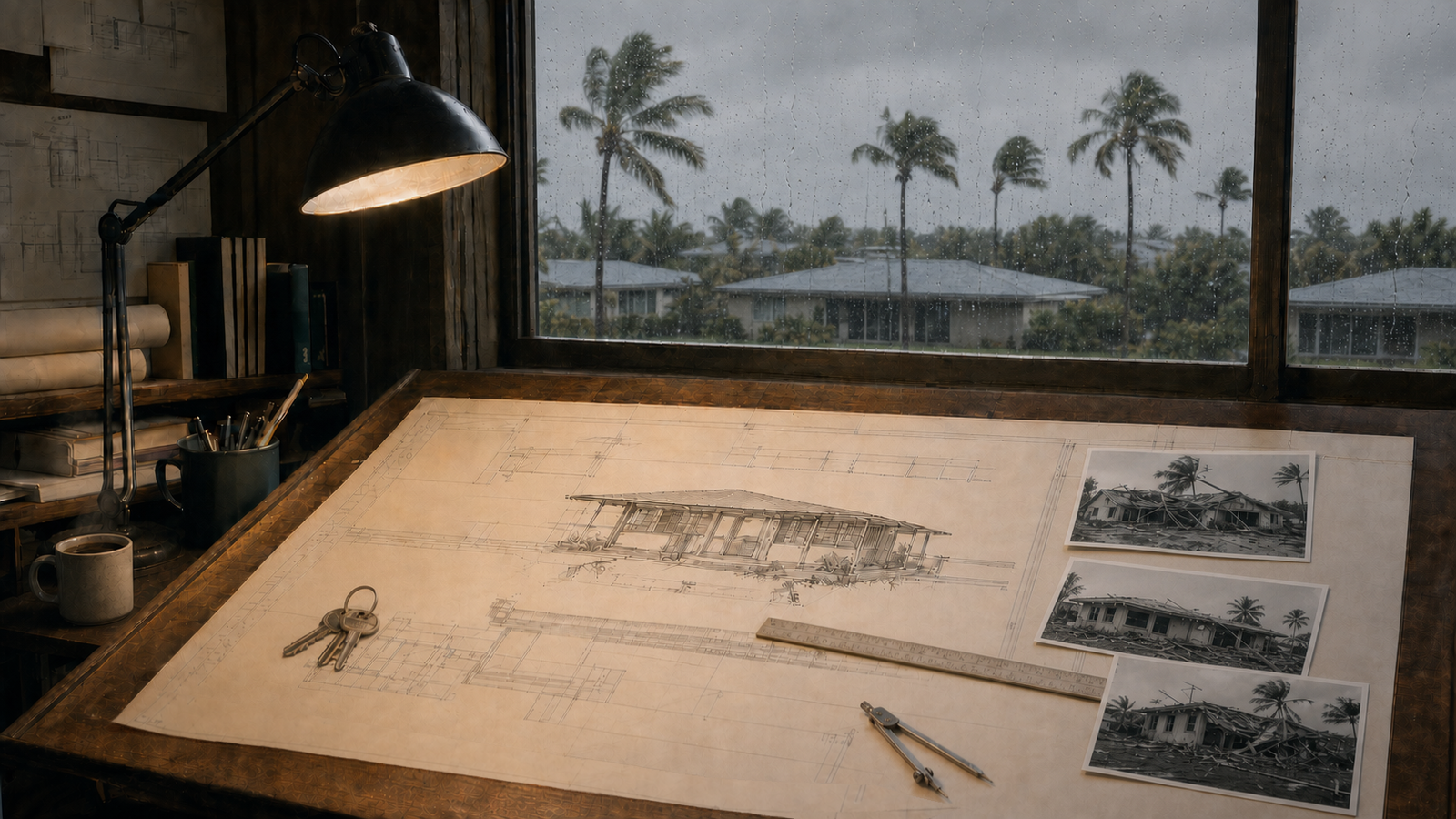
Herbert Saffir was not a meteorologist. He was a civil engineer who moved to South Florida in 1947 and became involved in improving Dade County’s building code. Hurricanes were not an abstract scientific interest for someone doing that work. Each major storm revealed how roofs, windows, walls, and construction standards performed when subjected to extreme wind.
Saffir studied that damage directly. He surveyed storm sites, photographed failed structures, and compared what happened to buildings under winds of different strengths. His concern was not simply how intense a hurricane had become over the ocean. It was what those winds could do after reaching something people had built.
That work eventually became part of a much larger assignment. The United Nations commissioned Saffir to help prepare guidance for economical construction in parts of the world exposed to tropical cyclones. The resulting 1975 publication, Low-cost Construction Resistant to Earthquakes and Hurricanes, covered building design, wind loads, construction methods, and hurricane-resistant structures. It was intended to be useful in places where strong hurricane building codes did not yet exist.
Saffir saw that earthquakes already had recognizable intensity scales, but hurricanes had no similarly simple way to connect wind strength with expected structural damage. He divided hurricane winds into five categories and described the damage likely within each one. In its original form, the scale was fundamentally an engineering tool.
The surviving accounts do not produce a perfectly tidy date for its conception. Saffir later remembered receiving the United Nations commission in 1969. Robert Simpson remembered discussing related work with him in 1968. The United Nations volume itself appeared in 1975. Those differences suggest that the scale evolved over several years instead of arriving in one finished moment.
The other man behind the scale had survived a catastrophe
Robert Simpson came to the problem from a very different direction.
In September 1919, when Simpson was six years old, a major hurricane struck the Corpus Christi area of Texas. The storm produced a surge of approximately 16 feet in the city. The official death toll was 284, but historians believe the true number may have been between 600 and 1,000 because many victims could not be identified.
Simpson survived. The experience of witnessing the storm’s destruction helped inspire a career devoted to understanding hurricanes, according to the National Weather Service history of the 1919 hurricane.
He later flew into tropical cyclones, became the first director of the National Hurricane Research Project, led Project STORMFURY, and served as director of the National Hurricane Center from 1968 through 1974. By the time Saffir was developing his damage categories, Simpson had spent much of his life trying to understand both the physical behavior of hurricanes and the challenge of warning people about them.
The two men therefore approached the same problem from opposite sides. Saffir studied what wind did to structures. Simpson studied the storms producing that wind and the decisions people had to make before it arrived.
Camille made the communication problem impossible to ignore
Hurricane Camille struck the northern Gulf Coast in August 1969 with catastrophic winds and storm surge. Afterward, the National Hurricane Center received more requests for quantitative descriptions of hurricane damage than it was prepared to answer.
People did not merely want to know the storm’s wind speed or central pressure. Emergency managers, relief organizations, public officials, and the public wanted to know what those numbers meant.
Simpson recognized that Saffir’s categories could provide the missing translation. A technical measurement could become a practical description of expected damage.
In a later account prepared for an American Meteorological Society conference, Simpson remembered that the decision to adapt Saffir’s work for National Hurricane Center use was reached during an extended lunch with senior staff. The scale was then modified for operational hurricane communication.
That recollection turns the history into something much more human than the invention of a scientific formula. One of the most recognizable systems in modern weather communication did not emerge from a single experiment or mathematical discovery. It grew from damage surveys, an international housing project, a catastrophic hurricane, conversations between two specialists, and a long meeting over lunch.
The wind measurement was a practical compromise
Even the wind standard behind the categories was not an obvious choice.
Saffir reportedly believed that very short gusts, lasting roughly ten seconds or less, might correspond more directly to the forces that damage buildings. His original United Nations material discussed extremely short gusts.
The problem was the historical record. Meteorologists did not have a reliable archive of brief peak gusts that could be applied consistently across past hurricanes. Much of the available information came from hourly aviation weather reports.
Simpson later recalled that they settled on the highest one-minute average wind because it was the measurement they could apply. The scale therefore uses maximum sustained winds averaged over one minute, not the strongest instantaneous gust inside the storm.
That decision still shapes hurricane communication. When the National Hurricane Center reports a hurricane with maximum sustained winds of 100 mph, it does not mean every place inside the circulation is experiencing 100 mph winds. It describes the estimated peak one-minute wind in the storm under the agency’s measurement standard. Local winds can be lower, while brief gusts can be higher.
The standard was useful because it made storms comparable. It was also a product of the data that existed at the time.
Storm surge never fit neatly into the categories
The history of storm surge is one of the scale’s greatest ironies.
Saffir’s original damage scale focused on wind and structural damage. Simpson and the National Hurricane Center wanted something that could describe the larger hurricane threat, so pressure and storm-surge guidance became associated with the operational scale.
Yet Simpson later recalled that surge had initially been kept separate for a good reason. Storm surge is not determined by maximum wind speed alone. It also depends on the storm’s size, forward motion, angle of approach, coastal shape, local topography, and the depth of the water near shore.
A temporary surge system based on a standardized coastline and bathymetry was developed for internal guidance. What began as a simplified operational aid eventually became part of the public scale.
For years, each category was associated with an expected range of storm surge. The pairing made the scale appear more complete, but it created the impression that category could predict coastal flooding.
Real hurricanes repeatedly showed why that was unreliable. The National Hurricane Center now uses the contrast between Hurricanes Ike and Charley to explain the problem. Ike reached Texas in 2008 as a Category 2 hurricane but produced peak surge values of about 20 feet. Charley struck Florida in 2004 as a Category 4 hurricane but produced a peak surge of only about 7 feet. Ike’s much larger wind field moved far more water even though its maximum sustained wind was lower. NHC’s technical explanation documents why the old category-based surge ranges failed.
In 2010, the National Weather Service formally removed storm surge, flooding, and central-pressure ranges from the scale. Its name changed from the Saffir-Simpson Hurricane Scale to the Saffir-Simpson Hurricane Wind Scale.
After decades of expansion, the scale returned closer to Saffir’s original purpose: describing the damage potential of wind.
The scale reached the public in stages
There is no single uncontested date when the scale suddenly became public.
Some NOAA histories say it entered operational use in 1972 and appeared in public alerts in 1973. Other records describe it as experimental in 1974. Simpson later recalled restricted operational evaluation in 1975 and public release in 1976. In a 1991 interview, he said the scale had already been used by organizations such as the American Red Cross and emergency managers for several years before broader public distribution.
Those accounts are not necessarily describing the same milestone. Development, testing, use by public-safety organizations, operational use by forecasters, and widespread public communication can happen at different times. The safest conclusion is that the scale moved through those stages during the first half of the 1970s.
Simpson also admitted that he was uneasy about broad public use.
He believed the scale could help emergency managers communicate different levels of risk, but he worried that it was being released before people had been adequately taught what it meant. He later said it had served a valuable purpose while also being misinterpreted and misused.
That concern now seems remarkably familiar. A category is easy to remember and easy to repeat. Those strengths also make it tempting to treat the number as a complete verdict on the storm.
Neither man expected the famous name
The scale was initially described with functional names such as the Hurricane Damage Potential Scale or Hurricane Disaster-Potential Scale.
Simpson later recalled that an annual hurricane review committee, with representatives from NOAA, the Air Force, and the Navy, recommended renaming it the Saffir-Simpson Hurricane Scale. According to him, both Saffir and Simpson were surprised when they learned their names had been attached to it.
There was another person in the background of its development. In the same retrospective, Robert Simpson credited his wife, Joanne Malkus Simpson, with influencing his thinking during their daily discussions about the scale’s final form.
Joanne Simpson should not be recast as a third co-creator. Robert’s acknowledgment is still significant. She was the first woman to earn a doctorate in meteorology and became one of the leading tropical meteorologists of her generation. Her research helped establish the role of towering tropical clouds in atmospheric circulation and hurricane intensification, and she later helped drive the creation of the Tropical Rainfall Measuring Mission. NASA’s account of her career shows that the person participating in those informal conversations was a major scientist in her own right.
Even the category boundaries have changed
The category lines can look like fixed boundaries imposed by nature. They are not.
In 2012, the National Hurricane Center changed the boundaries around Category 4 by one mile per hour. Category 4 had previously covered 131 to 155 mph. It now covers 130 to 156 mph.
The reason was not a new discovery about buildings or hurricane physics. NHC assigns intensity in five-knot increments, then converts those values into miles and kilometers per hour. Rounding could place the same storm in different categories depending on which unit a reader used.
For example, 115 knots converts to about 132.3 mph, which rounds to 130 mph in an advisory. Under the old boundaries, 115 knots was Category 4 while 130 mph was Category 3. The 2012 adjustment removed that contradiction.
No historical hurricane changed category because of the revision. The boundaries moved so that the different units would agree.
It is a small but revealing detail. Even familiar scientific categories contain choices about measurement, communication, available data, and what information needs to remain consistent.
Why the scale stops at Category 5
Category 5 has no upper limit. That has led to recurring proposals for a Category 6, especially when exceptionally powerful hurricanes develop.
Simpson’s explanation was rooted in the scale’s original purpose. Once winds exceed the Category 5 threshold, he believed the additional structural damage was already severe enough that another category would not meaningfully change the warning. Even well-engineered buildings can suffer serious failures at those wind speeds.
The open-ended category does not imply that hurricanes cannot become substantially stronger than 157 mph. It means the creators did not see another wind-damage category as operationally useful.
A future authority could reconsider that judgment, but Category 5’s open end is not an oversight. It reflects what the scale was built to communicate.
The scale succeeded because it simplifies
The Saffir-Simpson Hurricane Wind Scale endures because it answers an important question quickly: How strong are this hurricane’s maximum sustained winds, and what kind of wind damage can winds of that strength produce?
It does that job well.
The problem begins when the answer is stretched beyond the question. Category does not measure the size of the wind field, total rainfall, flash-flood potential, storm surge, waves, rip currents, tornadoes, duration, forward speed, or the vulnerability of a particular community. A large tropical storm can create effects that a compact hurricane does not. A weakening cyclone can continue producing destructive rain. A storm passing offshore can still send dangerous surf or moisture into Baja California Sur.
That does not make the scale defective. It makes the scale specific.
The story of its creation helps explain both its power and its limits. It was built to translate wind into likely structural damage. It was expanded to carry more information, then narrowed again when experience showed that some hazards could not be reduced to the same number.
For Baja, category should remain one part of a larger picture that includes the forecast cone, the storm’s actual and projected path, wind-field size, rainfall, terrain, surf, watches and warnings, and guidance from NHC, SMN/CONAGUA, Protección Civil, and local authorities.
The category is important. It was never meant to tell the whole story.
The current Saffir-Simpson Hurricane Wind Scale
The current scale is based only on a hurricane’s maximum sustained one-minute wind. Categories 3, 4, and 5 are classified as major hurricanes. The descriptions below summarize the wind damage associated with each category. They do not describe expected rainfall, flooding, storm surge, tornadoes, or surf. National Hurricane Center reference
Category 1
Sustained winds: 74-95 mph · 64-82 kt · 119-153 km/h
Very dangerous winds will produce some damage.
Well-constructed frame homes may sustain damage to shingles, siding, roofs, and gutters. Large tree branches can break, and shallow-rooted trees may topple. Damage to power lines and poles can cause outages lasting from a few days to more than a week.
Category 2
Sustained winds: 96-110 mph · 83-95 kt · 154-177 km/h
Extremely dangerous winds will cause extensive damage.
Well-constructed homes can sustain major roof and siding damage. Many shallow-rooted trees may snap or be uprooted, blocking roads. Near-total power loss is possible, with outages lasting from several days to several weeks.
Category 3, major
Sustained winds: 111-129 mph · 96-112 kt · 178-208 km/h
Devastating damage will occur.
Well-built framed homes may suffer major damage, including the loss of roof decking and gable ends. Many trees can be snapped or uprooted, leaving roads blocked. Electricity and water may remain unavailable for days or weeks.
Category 4, major
Sustained winds: 130-156 mph · 113-136 kt · 209-251 km/h
Catastrophic damage will occur.
Well-built framed homes can lose most of their roofs or some exterior walls. Most trees may be snapped or uprooted, and power poles can be brought down. Fallen trees and poles may isolate residential areas. Power outages can last weeks or months, and some affected areas may remain uninhabitable for an extended period.
Category 5, major
Sustained winds: 157 mph or higher · 137 kt or higher · 252 km/h or higher
Catastrophic damage will occur.
A high percentage of framed homes may be destroyed, including complete roof and wall failures. Fallen trees and power poles can isolate communities. Power outages may last for weeks or months, and much of a severely affected area may remain uninhabitable for a prolonged period.
These are general NOAA wind-damage descriptions, not a location-specific forecast for Baja California Sur. Actual damage depends on construction quality, building codes, maintenance, terrain, exposure, wind duration, debris, and the part of the hurricane that reaches a location.
Sources
- Low-cost Construction Resistant to Earthquakes and Hurricanes — United Nations Department of Economic and Social Affairs
- Background and Motivations for the Saffir/Simpson Scale — American Meteorological Society
- The Hurricane of 1919 — National Weather Service
- 50th Anniversary of Hurricane Camille — NOAA Atlantic Oceanographic and Meteorological Laboratory
- Implementation of the Saffir-Simpson Hurricane Wind Scale — National Weather Service
- 2012 Revision to the Saffir-Simpson Hurricane Wind Scale — National Hurricane Center
- Saffir-Simpson Hurricane Wind Scale — National Hurricane Center
- Joanne Simpson, 1923-2010 — NASA Earth Observatory