
Climate · Environment · Storms
When No Hurricane Is the Disaster
After Hurricane Kay damaged rural communities, nearly every rancher surveyed still viewed it positively. Their answers point to a quieter threat facing Baja California Sur.
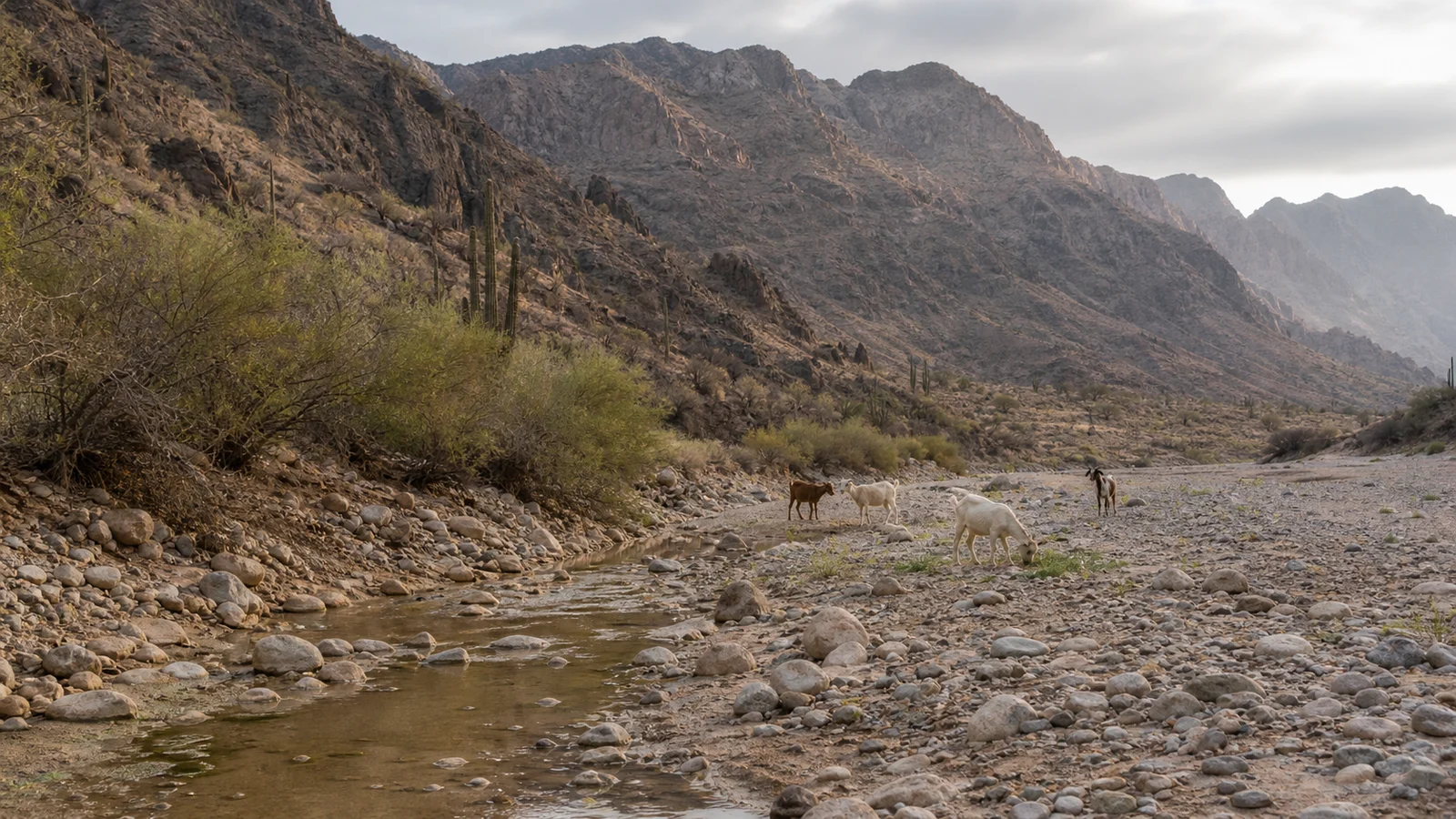
For most people, a hurricane is something to hope will turn away. Along the coast, that instinct is grounded in experience. Tropical cyclones can destroy homes, wash out roads, cut electricity and communications, and turn normally dry channels into violent floods. But in parts of Baja California Sur’s interior, there is another danger that is slower, quieter, and easier to overlook. It arrives when the summer rains fail.
A 2025 study of traditional ranching households in the southern Sierra de la Giganta documented a finding that initially seems difficult to reconcile. After Hurricane Kay damaged property, killed livestock, contaminated water sources, and isolated rural communities in 2022, nearly every respondent still viewed the storm positively. That sounds almost impossible until you look at how these families live and which danger had already pushed them closest to the edge. It does not mean hurricanes are good, and the study does not represent everyone in BCS.
Kay arrived after years without enough rain
From 2020 through 2022, the Sierra de la Giganta and much of the North American arid West endured one of the most extreme droughts on record. In the Giganta, the consequences were immediate for families whose livelihoods depended on cattle and goats. Permanent desert springs supplied much of the daily drinking water, but seasonal rain performed a different job. It produced the vegetation that livestock could eat while roaming the landscape.
When that vegetation failed, ranchers had to buy feed for longer periods, take on debt, sell assets, reduce their own consumption of livestock, or watch animals die. Then Kay arrived. According to the National Hurricane Center’s final report, the storm reached Category 2 strength over the Pacific before weakening. It made landfall near San Rafael in Baja California Sur on September 8, 2022, with maximum sustained winds of 60 knots, which made it a strong tropical storm at landfall.
The loss of hurricane status did not make it harmless. Kay brought widespread tropical-storm-force winds and extraordinary rainfall to the peninsula. NHC reported 383 millimeters at Guadalupe and 370 millimeters at San Francisco de la Sierra. Flooding and landslides closed roads, isolated communities, damaged schools, and disrupted power. Two people died in a vehicle accident after a highway collapsed in BCS; NHC classified those deaths as indirect. For the ranching communities included in the later study, Kay caused serious damage while also bringing the rain that broke the drought.
Why the rain mattered so much
Researchers interviewed 100 rural households in the southern Sierra de la Giganta during October and November 2022, soon after Kay. This was a deliberately local study. It did not survey all ranchers in Baja California Sur, much less the state’s urban and coastal population. Even within that limited group, the reported damage was substantial:
- All 100 households experienced some form of local infrastructure damage, especially to dirt roads.
- Seventy-eight reported at least one personally negative consequence.
- Sixty-two were unable to travel to urban areas; among those providing a duration, the average disruption was about two weeks, and one lasted 60 days.
- Thirty-three households reported damaged property or lost livestock, with combined reported losses approaching US$14,000.
- The households collectively reported losing 12 cattle and 78 goats.
- Twenty-seven had to change their primary source of fresh water.
Some roofs were lost, some walls fell, children missed school, and families were separated from markets and services. Yet among the 99 people who answered the study’s perception question, 96 characterized Kay positively and three were neutral. Not one person chose the negative response.
The positive responses did not dismiss the damage. Kay’s rain restored forage and reduced the need to borrow money, buy feed, sell assets, or watch more animals die. Those immediate losses were serious, but years without enough rain had put the future of ranching itself at risk.
A landscape organized around rare water
The Sierra de la Giganta is not simply a dry place waiting for ordinary rainfall. It is an ecosystem, and the basis of a human livelihood, organized around highly seasonal and irregular water. Warm-season tropical systems can produce a rapid “green-up” that persists after the storm has passed. Plants become livestock feed, springs and aquifers may receive recharge, and ranching families can enter the next dry season with more vegetation on the land and less purchased feed on their accounts.
Independent hydrological research supports the importance of tropical rainfall below the surface as well. A groundwater study led by Christopher Eastoe used chemical signatures in rain and groundwater to identify the water’s likely origin. The researchers concluded that hurricane rain was the predominant source of recharge in southern Baja California within the areas studied. They also reported that tropical systems bringing more than 50 millimeters of rain had historically occurred about once every two to three years.
That does not mean every hurricane replenishes every aquifer, or that one wet storm solves water scarcity. Rainfall intensity, location, soil, geology, runoff, pumping, and prior conditions all matter. A deluge can produce destructive flooding while much of its water escapes to the sea. Groundwater may receive recharge at the same time that roads, homes, and fields are being damaged above it. In an arid region, water can be both a hazard and a necessity during the same storm.
One storm could not solve the larger problem
Ninety-one of the 100 households said Kay’s warm-season rain meant the drought was over, but only 43 thought ranching would become easier over the long term.
The researchers describe families living near a social and ecological threshold. Drought had increased livestock deaths, forced difficult financial decisions, and driven some ranchers toward urban employment. In related work, ranchers estimated that they might endure roughly two or three years of sustained drought before having to abandon ranching altogether.
Kay restored vegetation for a time, but it could not make future rainy seasons predictable, reduce growing water demand, repair every road, or secure ranching’s future. The respondents were not expressing a general preference for hurricanes. They were describing how urgently their livelihoods depended on the seasonal rain.
The same storm can produce different disasters
For a family in a flood-prone neighborhood, Kay may be remembered through mud, lost property, or a dangerous evacuation. A hotel or fishing business may remember closures and lost income. A ranching household that was already buying feed on credit after years of drought may also remember Kay as the rain that allowed its livestock, and the household economy built around them, to continue. Those experiences are different, but none is less real than the others.
Warnings still need to be clear about wind, flooding, surf, and damaged infrastructure. But Kay also shows why category and landfall do not explain how every community experiences a storm. For the ranchers in this study, a season without a hurricane did not necessarily mean safety. After several dry years, the greater danger was another failed rainy season and the possibility that the land could no longer support their herds or their way of life.
Sources
- Mitigating climate shocks requires understanding local perceptions — Journal of Arid Environments
- Tropical Cyclone Report: Hurricane Kay (EP122022) — National Hurricane Center
- Identifying Recharge from Tropical Cyclonic Storms, Baja California Sur, Mexico — Groundwater
- Decision-making under climate shocks and economic insecurity: Ranching in rural Baja California Sur, Mexico — Evolution and Human Behavior